June 24, 2026 · 6 min read
How To Track Hair Loss Progress At Home
Track hair loss progress at home by using the same photos, same lighting, same angles, and simple notes every week. The goal is to compare evidence, not chase every mirror moment.
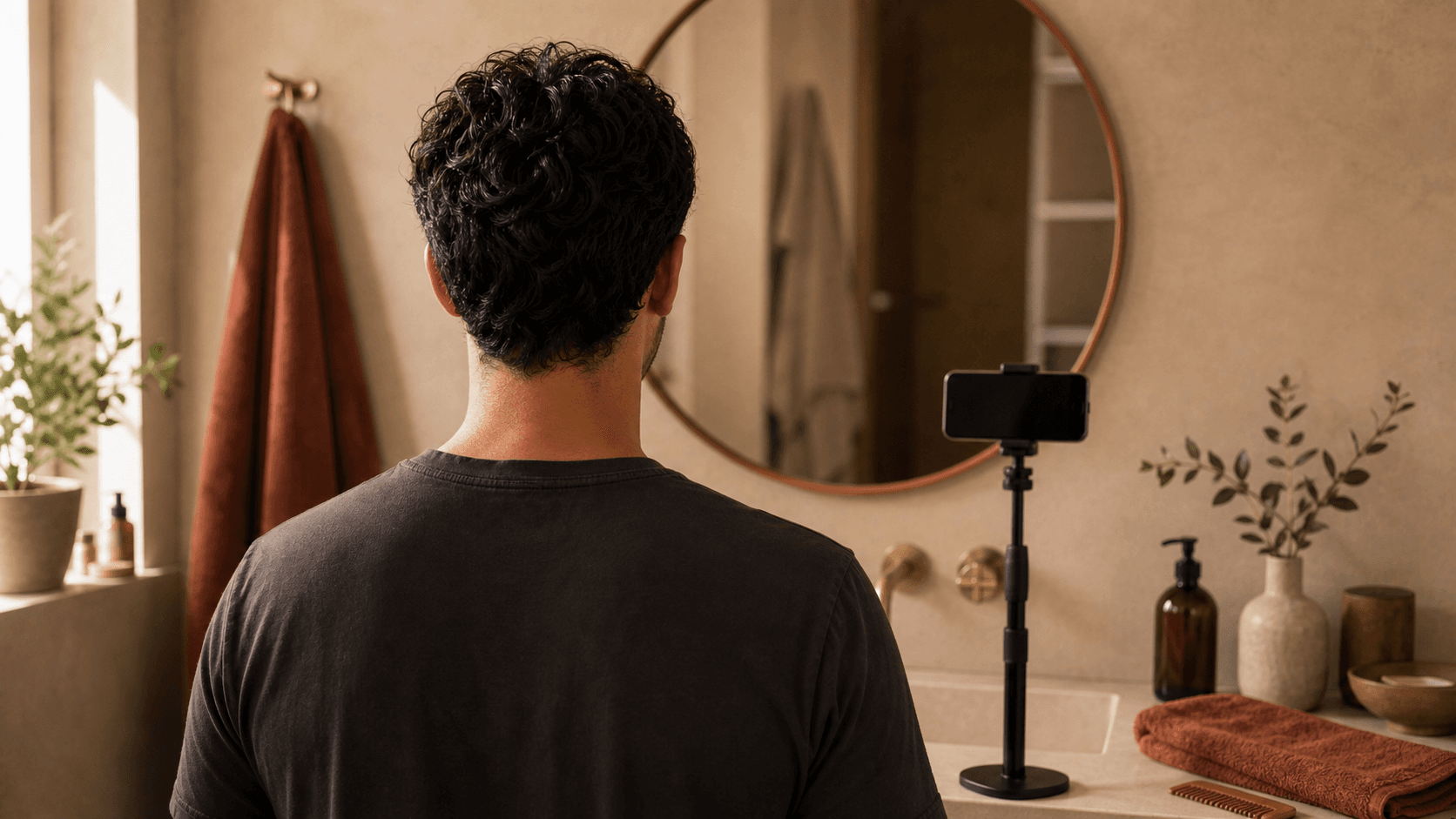
The short version
- The best way to track hair loss progress at home is with repeatable photos, not daily mirror checks.
- Use four angles: front, crown, left side, and right side.
- Keep lighting, distance, hair state, and timing the same every week.
- Add short notes about wash day, products, haircut, stress, and styling changes.
- Compare monthly trends instead of reacting to one bad photo.
You cannot track hair by memory. Your brain will rewrite the evidence depending on your mood, lighting, and how worried you feel that day.
That is why tracking matters.
If you want to track hair loss progress at home, you need a boring system. Same photos. Same light. Same angles. Same timing. The point is not to create flattering pictures. The point is to create pictures you can compare.
Here is the simplest setup that gives you useful evidence without turning your bathroom into a photo studio.
Pick four angles and stick to them.
Do not take random photos every time your hair looks strange. Random photos create random conclusions.
Use four repeatable angles:
- Front hairline
- Crown
- Left side
- Right side
These zones cover the places people usually notice change first. The front shows hairline shape. The crown shows density and scalp visibility. The sides show temple shape and how hair sits around the face.
Take each photo the same way every week. Same room, same mirror, same distance, same camera height. If you change the angle, you change the evidence.
The crown photo is the hardest, so make it easy. Use a phone stand, a mirror, or a consistent arm position. Do not chase perfection. Chase repeatability.
early hair loss signsControl the variables that trick you.
Hair can look completely different depending on the conditions.
Wet hair exposes scalp. Oily hair separates. Product can flatten roots. A fresh haircut can remove bulk. Harsh overhead light can make a normal part look dramatic. A low camera angle can make the hairline look higher.
If you want to track hair loss progress accurately, remove as many variables as possible.
Use this baseline:
- Clean, dry hair
- No hat compression
- No wet roots
- Same light source
- Same time of day if possible
- Same hairstyle or part
- Same distance from the camera
If one photo looks worse, check the context before reacting. Was your hair oily? Did you use a heavy product? Did you take it under a different light? Did you just get a haircut?
The cleaner the setup, the clearer the answer.
Keep notes short.
You do not need a complicated journal. You need enough context to explain why a photo might look different.
After each weekly photo set, write one or two lines:
- Wash day or day after wash
- Product used
- Haircut date
- Stress or sleep disruption
- Hat or tight hairstyle that day
- Anything unusual about lighting or styling
Short notes prevent bad conclusions. If week three looks thinner but you also used more product and took the photo at night, you know not to overread it.
This is especially useful for shedding concerns. A heavy shower day might look scary, but if your weekly photos are stable, the bigger picture is calmer. hair loss vs shedding
Compare monthly, not hourly.
Daily checking is tempting, but it usually makes the signal worse.
Your hair changes from morning to night. It changes after a shower, after a workout, after a hat, after styling, and after touching it too much. If you check constantly, you will find something new to worry about every time.
Weekly photos are enough. Monthly comparisons are better.
Put week one beside week four. Look at the same zone. Ask whether coverage, shape, or scalp visibility changed in a repeatable way. Do not zoom into one strand. Do not judge based on a single harsh photo.
The question is simple: does the same area look different across consistent photos?
That is the whole point of tracking. It moves you from panic to evidence.
Use a tool when consistency gets hard.
The hard part of tracking is not taking a photo. It is taking the same photo.
That is where guided scanning helps. Morph asks for the same key views, then turns those photos into a Hair Health Score across scalp health, density, hairline, and thickness. That gives you a baseline you can compare week to week instead of guessing from scattered camera roll photos.
You can still track manually, and you should understand the basics either way. But a guided system removes a lot of the friction: where to aim, what to compare, and whether the change is happening in the same zone.
hair health scoreFrequently asked questions
How often should I track hair loss progress at home?
Once a week is enough for photos. Compare trends monthly so you do not overreact to day-to-day styling changes.
What photos should I take?
Take front, crown, left side, and right side photos. Those four angles cover the areas where most visible changes show up first.
Should my hair be wet or dry?
Use clean, dry hair. Wet hair clumps together and exposes more scalp, which makes comparison less fair.
What lighting is best?
Use consistent lighting. Soft natural light or the same bathroom light works better than switching between daylight, flash, and overhead bulbs.
Should I count shed hairs too?
You can note unusual shedding, but photos matter more for progress. Loose hairs are noisy. Visible coverage over time is the stronger signal.
How do I know if the photos show real progress?
Look for repeatable changes in the same zones across several weeks. One better or worse photo is not enough.
Early access
Know exactly what's wrong with your hair
Morph scans your scalp with AI, gives you a Hair Health Score across 4 dimensions, and builds your personalised 12-week plan based on your actual results, not generic advice.
Join the waitlist →More from Morph
All articles6 min read
Best Apps To Track Hair Growth And Loss In 2026
The best hair growth tracker app is the one that helps you take consistent photos, compare the same zones, and understand whether your routine is actually changing anything. In 2026, tracking matters more than another folder of random camera roll photos.
6 min read
What Is A Hair Health Score And How Is It Calculated
A hair health score turns your hairline, density, thickness, and scalp condition into one trackable number. The useful part is not the score by itself, but how it changes over time.